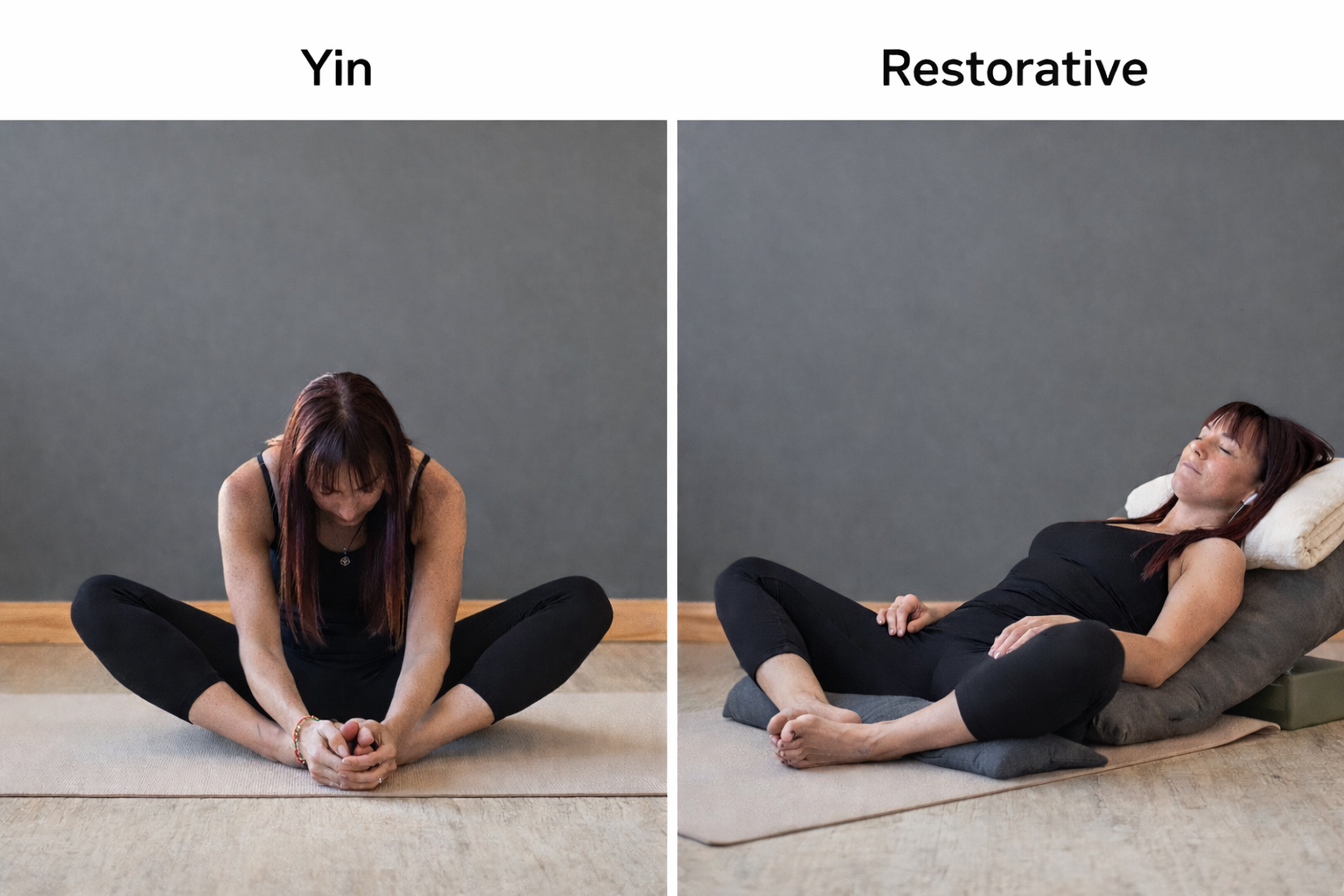
Yin vs. Restorative Yoga
Yin Yoga vs. Restorative Yoga: What's the Difference?
If you've ever scrolled through a yoga schedule and wondered whether to choose a yin class or a restorative class — and honestly what the difference even is — you're not alone. Both styles are slower, quieter, and deeply nourishing. But they work your body and mind in different ways, and knowing the distinction can help you choose exactly what you need on any given day.
At Hush Studio in East Brunswick, NJ, both yin and restorative yoga are part of our regular offerings — and we hear this question often. Here's a clear, grounded look at each practice.
What Is Yin Yoga?
Yin yoga is a slow-paced practice in which poses are held for extended periods — typically three to five minutes, sometimes longer. While that might sound easy, yin is actually quite a specific and deliberate form of practice. Its purpose is to work into the deeper connective tissues of the body: the fascia, ligaments, tendons, and joint capsules. These tissues don't respond to the short, dynamic engagement of more active yoga styles. They require sustained, gentle stress held over time.
In yin yoga, the muscles are meant to be relaxed rather than engaged. You sink into a pose, find your edge — the place where you feel sensation without strain — and you stay there. The stillness is intentional. The discomfort you may feel is the sensation of your connective tissue slowly releasing.
Yin is also a deeply meditative practice. Holding poses for several minutes invites you to sit with yourself, observe your thoughts, and cultivate patience. Many students find it humbling in the best possible way.
Best for: building flexibility and joint mobility, releasing chronic tension, calming an overactive mind, and complementing more active practices like vinyasa or Pilates.
What Is Restorative Yoga?
Restorative yoga takes a different approach entirely. Where yin asks you to feel sensation and breathe through it, restorative yoga is designed to eliminate sensation and bring the body into a state of complete rest.
Restorative classes use an abundance of props — bolsters, blankets, blocks, straps, and eye pillows — to support the body so fully that no muscle needs to work. You are not stretching. You are not holding anything up. You are simply being held. Poses are typically passive shapes — like a supported child's pose or a reclined twist — where the goal is total relaxation of the nervous system.
The practice is rooted in the work of B.K.S. Iyengar and later popularized by Judith Hanson Lasater. It is explicitly therapeutic, often used to help the body recover from illness, burnout, grief, or chronic stress. A restorative class might only include three to five poses in a full hour — and that is entirely by design.
Best for: nervous system recovery, healing and rest, stress and anxiety relief, illness or injury recovery, and anyone who needs full permission to do nothing.
How Do They Differ?
The most useful way to think about it: yin yoga works your body, while restorative yoga rests your body. Both do so slowly, gently, and mindfully — but their intentions are distinct.
• In yin, you feel sensation. In restorative, you aim to feel nothing.
• Yin targets connective tissue through passive, sustained stress. Restorative targets the nervous system through total support and release.
• Yin typically uses fewer props. Restorative relies heavily on props to make each shape fully supported.
• Yin poses may feel challenging to hold. Restorative poses should feel immediately comfortable.
• Yin is still and quiet, but you are present with sensation. Restorative invites you to drift toward sleep.
Neither practice is "better." They simply serve different needs — and honestly, most people benefit from both at different times.
Which One Is Right for You?
If your body feels tight, stiff, or restricted — especially in the hips, spine, or shoulders — yin yoga can help work through that layer over time. If your nervous system feels frayed, your schedule is relentless, or you're recovering from something that has depleted you, restorative yoga may be exactly the reset you need.
Many regular practitioners at our East Brunswick studio find that they gravitate toward yin on weeks when they feel strong and grounded, and toward restorative on weeks when they feel worn down. Both are welcome here.
Experience Both at Hush Studio
Hush Studio NJ offers yin yoga and a range of slower, intentional practices as part of our regular class schedule. We are located at 330 Milltown Road, Suite C-32, in East Brunswick, and we welcome practitioners from across the area — including North Brunswick, South Brunswick, Milltown, Old Bridge, and beyond.
Whether you're coming for your first yoga class or returning to deepen a longtime practice, our studio is a space to slow down, breathe, and feel at home.
Check our current schedule and reserve your spot at hushstudionj.com.